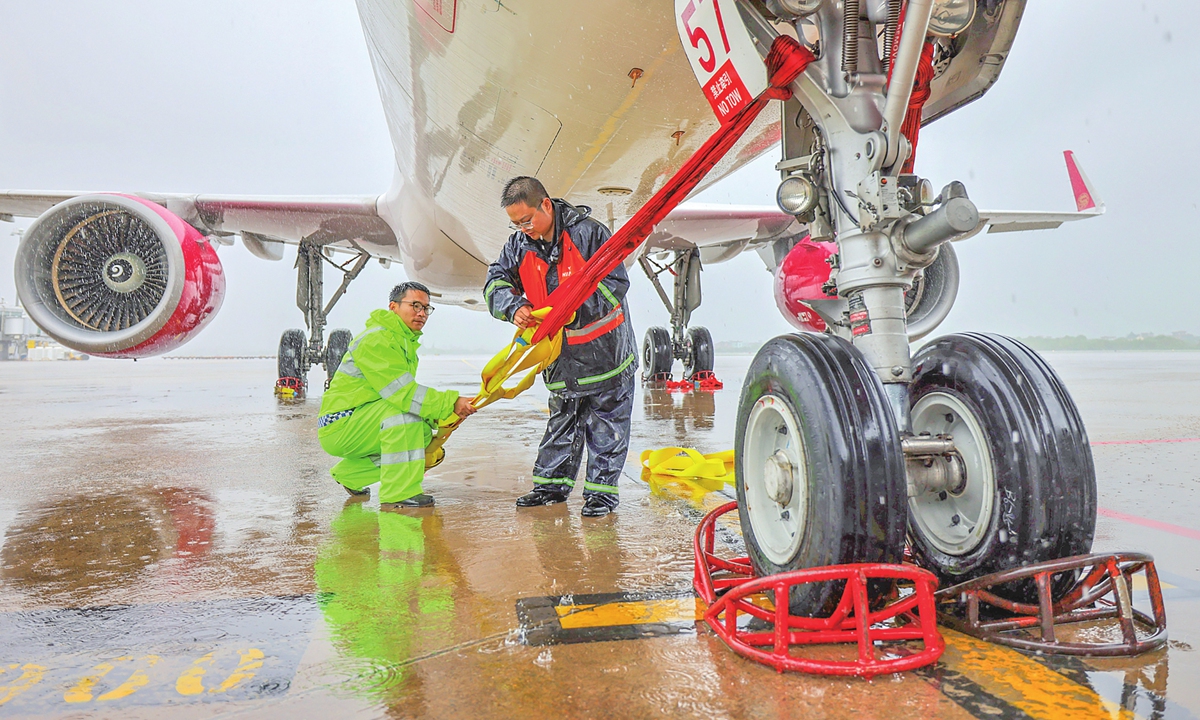
Staff members secure aircraft at Hangzhou Xiaoshan International Airport to prepare for Typhoon Dolphin on August 9, 2026. Photo: VCG
Typhoon Dolphin made landfall in Taizhou, East China's Zhejiang Province, on Sunday afternoon, bringing strong winds up to 42 meters per second and heavy torrential rain to the coastal regions amid a red alert - the highest level in the country's typhoon warning system - issued for it earlier that day.
Authorities in East China's Fujian have relocated nearly 100,000 residents, while coastal provinces are suspending railway services and canceled flights, making an all-out effort to mitigate possible risks.
The NMC maintained orange rainstorm and blue severe convective weather alerts at 6 am on Sunday, forecasting exceptionally heavy rainfall of 250 to 440 millimeters in some areas along the eastern coast of Zhejiang, with heavy to torrential rains expected across Jiangsu, Zhejiang, Shanghai, and Anhui between Sunday morning and Monday morning, China Central Television (CCTV) reported.
In response to the typhoon, China's meteorological authority on Sunday upgraded its emergency response for severe meteorological disasters from Level III to Level II.
Fujian raised the emergency response level for typhoon prevention to Level II at 9 am on Sunday.
As Typhoon Dolphin gathers strength and approaches the coastal areas, Fujian's flood control authority, as of 6 pm on Saturday, deployed a total of 17,800 officials to and relocated 98,900 people from high-risk areas, Xinhua News Agency reported on Saturday.
Fujian has suspended all 115 marine engineering projects and moved 290 construction vessels to safe waters, while 55 passenger ferry routes in affected waters have been halted, chinanews.com reported.
Meanwhile, railway services in the affected regions including Fujian, Zhejiang, Shanghai have also been suspended from Sunday to Monday, according to chinanews.com.
Fujian authorities have urged stronger safety measures for returning vessels, offshore platforms and coastal and island tourism, as well as reinforcement of aquaculture facilities. They also called for timely evacuations from flood- and landslide-prone areas to guard against secondary disasters from the typhoon and heavy rain, chinanews.com reported.
In Zhejiang, Wenzhou city has closed all 85 A-level national tourist attractions, turned away more than 7,400 visitors and evacuated over 1,600, with the relocation effort ongoing, according to CCTV. Next, Wenzhou will next implement a "five suspensions" policy, halting outdoor group activities, classes, work, business operations and transportation.
All fishing vessels at Shitang Fishing Port in Wenling, Zhejiang, have returned to port, with all personnel evacuated ashore and maritime rescue teams on standby. Authorities urged vessels to stay off the sea during the typhoon.
In Shanghai, Pudong and Hongqiao airports operated at reduced capacity on Sunday, with nearly 60 percent of flights canceled. A total of 1,384 flights are scheduled to be canceled including 871 at Pudong and 513 at Hongqiao. Passengers are advised to check with their airlines for the latest updates and adjust travel plans accordingly, according to CCTV.
According to Hu Xiao, meteorological analyst at the NMC, the typhoon has several notable features, including its strong intensity and expansive circulation. The typhoon also has several unusual features. Forming unusually far east, near 180°E, it has traveled more than 7,200 kilometers, making its potential landfall in China a rare event and possibly the easternmost such landfall since 1951. Its 12-day lifespan is also well above the typical seven-to-10-day average, CCTV reported.
According to Ma Jun, director of the Institute of Public and Environmental Affairs, Typhoon Dolphin traveled a long distance and remained at typhoon or severe typhoon strength of its lifespan so far. Despite passing through some areas that were unfavorable to its development, its powerful inner core remained intact, while its extensive cloud system continued to absorb moisture and energy, fueling the potential for torrential rainfall.
The typhoon has remained at sea for more than 260 hours and experienced a rare "three rises and three falls" in intensity. Its unusually long lifespan has allowed it to absorb more moisture and energy, while repeated intensity fluctuations have complicated forecasts of its future track and intensity of wind and rainfall, according to CCTV.
After landfall, Typhoon Dolphin may move slowly, prolonging heavy rainfall and raising the risk of extreme precipitation and related disasters. Its track later in the week remains uncertain as it could interact with the southwest monsoon and cold air from the northwest, potentially broadening and intensifying its impacts, Ma told the Global Times on Sunday.
。 中国小康网 独家专稿文|曲雪松认识黄姚古镇之前,先知道的,是黄姚豆豉。 认识黄姚古镇之前,先知道的,是黄姚豆豉。朋友从广西带回来的,小小一瓶,摆在餐桌上并不起眼,可是打开之后,一股奇特的浓香扑鼻而来,也牢牢锁住了味蕾。能有如此绵长而回味无穷的香气,想必,也是有一番独到的制作工艺吧,那又是怎样的一片山水,和民间智慧的积淀呢? 以至于几年之后,当我置身于古镇,再次被这一袭浓香包围时,竟像是见到了一位阔别已久的老朋友,感觉分外亲切。这香气,是随着晨曦的光晕一起,将古镇唤醒的。青墙黛瓦的岭南特色建筑,在古老高大的榕树掩映下,散发出岁月悠悠的烟火气息。九宫八卦布局的石屋,错落在山间的平地之上,看似随意,实则有序。绝大多数房屋和街巷都保留了原汁原味的风貌,脚下的青石板路泛着被岁月打磨的光泽,仿佛留存着当年商队走马驰骋的痕迹。 目之所及,早起的人们开始忙碌,孩子们四处奔跑呼唤小伙伴,欢声笑语此起彼伏。
B | 街上的小店陆续开门营业,卖菜的居民、旅行的游客沿着镇里街巷穿梭于每一个角落,而就在这些角落之间,不时的,能闻到阵阵酱香,香味儿源头,就是门店前一个个小缸里的豆豉酱、辣椒酱及各式酱菜,其间,都有豆豉的身影。街边小店炉火上的平底铁锅里,滋滋作响的油煎豆腐,撒一把豆豉,就有沁入心脾的香味升腾出来;隔壁,一大碗新出锅的热汤米线里,加一勺豆豉和猪肉碎炒制而成的拌料,汤汁就鲜美无比,能让人一口气喝到见底儿。
C | 这时你会不由得感叹,这豆豉,简直就是古镇的灵魂。 当地朋友介绍,豆豉的历史已经有几百年之久。它是以当地特产的黑豆为主料,用当地的水,以及当地人世代流传的古法工艺制成,没有任何添加剂,干净而纯粹,虽然诞生于大山之中,却早已名声在外,远销东南亚各国。甚至,当地的史料记载,过去从这里考中的举人,千里迢迢赴外地上任,行囊中都少不了豆豉酱,因此还流传着一首打油诗:“县官爱豆豉,味道果然长。
D | 一餐没豆豉,下饭总不香。”可不是么,离乡在外的人都有同感,故乡的山水带不走,故乡的味道却是可以装在行囊中的,即便只是小小的一瓶一罐,也能抚慰山高水远的思乡之情,哪拍只是片刻。 不过对现代人来说,虽地处广西贺州昭平县东北部的深山之中,古镇也算不上遥远了,从桂林开车两个小时就能到达。大山仿佛是她的深闺,阻隔了尘嚣,也独辟了这一处清幽古韵。镇子里最让人难忘的景观,是位于镇中低洼地段的仙人古井。这是一口建于明朝万历年间的古井,和别处圆圆泉眼的古井不同,它是由几座方池相连,每个方池都有限定的功能,按水流的方向,依次分为饮水、洗菜、洗手、洗衣之用,所有的泉水最后汇入河中。
E | 朋友说,制作豆豉的水与这里的井水是同源,只有这里的水,才能成就豆豉的奇香。每年的农历七月初七,镇里会举行一项特别的民俗活动 “取水节”。这一天,古镇的居民都会来到仙人古井取水,据说这一天的井水有着特别的神力,可以保佑家人平安健康。
H | 生活里有诗,但没有所谓的远方,因为它就在眼前,我用笔用心记录的每一个瞬间。 离乡在外的人都有同感,故乡的山水带不走,故乡的味道却是可以装在行囊中的,即便只是小小的一瓶一罐,也能抚慰山高水远的思乡之情,哪拍只是片刻。 (《小康》·中国小康网 独家专稿) 本文刊登于《小康》2024年4月下旬刊。


